

If you hang out with technologists, you have heard Amara’s law. Humans tend to overestimate the short-run effect of technology and underestimate its long-run effect.
Decades of experience inform this bit of wisdom. Roy Amara worked as a policy analyst at two think tanks, the Stanford Research Institute and the Institute for the Future. His law highlights a forecasting bias arising from two sources. Excitable humans lose sight of the mundane reasons why technologies have little immediate impact. Additionally, humans also overlook how consequences compound, producing dramatic results over long periods.
Amara made an art of systematic thinking about future possibilities. While a column cannot fully cover all his insights, there is enough room to focus on just the economics, which are rich.

The Short Run: Friction, Not Failure
Start with the short run. When a technology product designed by highly skilled engineers arrives in the world, the world looks nothing like the one in which it was conceived. Inside the lab or the startup, problems are defined, constraints are explicit, and incentives are aligned. Some engineers, especially inexperienced ones, also tend to have a narrow view of both the application of the product and the use.
Outside the lab or startup, a new supply meets the realities of demand. Users show up and, from a designer’s perspective, put assumptions about user behavior to the test.
The early overestimation of impact is not simply a result of enthusiasm. It is a systematic misunderstanding of demand, usually due to an underestimation of economic friction.
These frictions are not dramatic. They are mundane, repetitive, and stubborn. Most users work in organizations that are not optimized for any single mission. They are coalitions of departments, each with distinct metrics, budgets, and priorities, some explicit and some not. Technology that appears obviously superior in isolation must pass through procurement processes, compatibility checks, training constraints, and informal resistance from users with established routines.
Technical designers rarely see this obstacle course initially. The first round of introduction fails for reasons that become obvious in retrospect. If the design team wants to win, the second and third rounds of revision yield to reality

An excellent example comes from the deployment of image recognition to dentists. Dentists don’t mind getting help from algorithms identifying cavities in X-rays, but that is not what sold dentists on the services of one provider in this space, VideaHealth. They succeeded by leaving the lab and meeting demand in all its messy glory.
VideaHealth changed its design after learning that dentists were enthusiastic about colored overlays on X-rays. Why? Because these could be shown to patients. That helped persuade reluctant patients to fill the cavity, addressing one of the biggest problems dentists face every day: patients leave with a diagnosis but without treatment.
It turns out there are rarely any substitutes for trial and error with users. For example, this also shaped generative algorithms and accounts for some of their initial success. OpenAI’s models did not work right away in 2019 or 2020, but successive iterations and deep conversations with beta users led to the inclusion of novel features. By November of 2022, they had refined it enough, and we know what happened then.
A similar process describes the earliest evolution of Coding assistants, which started as a project engineered by GitHub management. Successive improvements have made their results more accessible to less technically adept users. The additional twist is that dozens of firms have entered this market and imitate one another. As soon as one firm learns about a useful feature from its users, many others develop their own versions.

This is not new.
It has always been so. The designers of Encarta, the first (and only) commercially successful encyclopedia on DVD, questioned the assumptions behind previous efforts.
After studying software buyers in retail outlets, they concluded that a potential customer, usually a parent, would spend no more than 3 minutes with the product before deciding whether to purchase it for their children.
The designers did not lament that buyers would not perform a thorough examination. They accepted it as a constraint, designing the pictures, sounds, and videos to grab attention in the store. In other words, they identified the friction and responded to it.
As another example, consider digital music in its early phase. MP3 compression was, by any technical standard, a technically marvelous invention. It reduced file sizes dramatically while preserving acceptable audio quality. From a design perspective, the problem was solved. Music could move across networks.
And yet, in the short run, the commercial system did not reorganize smoothly around that capability. Napster demonstrated demand, but it also revealed the absence of legal frameworks, licensing agreements, and viable payment models.
The design worked, but the market lacked a sustainable path forward. The frictions were everywhere: in copyright law, in record label incentives, in consumer payment habits, and in the absence of integrated distribution platforms. Those are economic constraints.
The development of Advanced Audio Coding (AAC) led to improvements for firms dealing with audio format for the music industry. Standards organizations defined the technical parameters. Alongside them, a different set of actors took on the task of defining how the standard would be monetized, reducing the licensing complexity for standards by assembling patent pools, defining standardized terms, collecting royalties, and distributing them among contributors.
AAC’s technical advantages, combined with a more predictable licensing environment, made it a suitable foundation for Apple’s iPod and iTunes. That did not eliminate piracy, but it did foster legal transactions, which many potential buyers wanted.
Don’t get me wrong. Sometimes these lessons are forgotten. Video codecs such as H.264 and later HEVC delivered remarkable gains in compression efficiency. But the algorithm was only the beginning. The system had to be negotiated. Any engineer involved in this area knows about the frictions, the grind of moving forward with multiple actors pulling in different directions. No participant calls the present solutions friction-free. Frictions have been the central problem in that area for many years.

More to the point, early forecasts are usually not naïve about technology, but they often fail to completely think through the economic frictions. The designers could not fully anticipate the organizational realities of the users they were trying to reach, or the extent to which divergent firm interests would distort outcomes. Firms “get things done” not because they are optimized, but because they are adaptable to these uneven frictions. A new technology must insert itself into that unevenness.
As the first half of Amara’s law predicts, the result is not failure, just a delay due to friction. Who is at fault for the errors about how long it would take? Blame the inevitable but overlooked friction, or those who had incomplete expectations?
The Long Run: Accumulation, Not Prediction
The long-run bias arises from different origins. Ironically, it arises because frictions do eventually get overcome, generating unforeseen consequences. It arises from the inherent challenges of foreseeing the combination of several accumulated changes.
For one, the dispersion of decision-making distorts economic outcomes. No single firm, designer, or planner controls the trajectory of the future. Understanding that dispersion requires a breadth that few possess.
Moreover, dispersion of experience creates traps related to the fallacy of composition, i.e., knowing something about one individual does not provide a representative example for the entire economy. The system is more than the sum of its parts.
Here is an example where we have had enough time to watch it develop in the long run. In 1995, the world was abuzz with excitement over the Internet and World Wide Web. What happened next? The actions of hundreds of thousands of firms, entrepreneurs, and users experimented in parallel.
What resulted? Firms learned from failure, imitated success, and gradually built complementary capabilities. Exaggerated claims were tested against user behavior, and flawed assumptions were discarded. Several generations of startups pushed new products, while some established firms retained their positions. That yielded something no one in 1995 could have possibly designed from scratch, namely, the commercial internet of 2025.
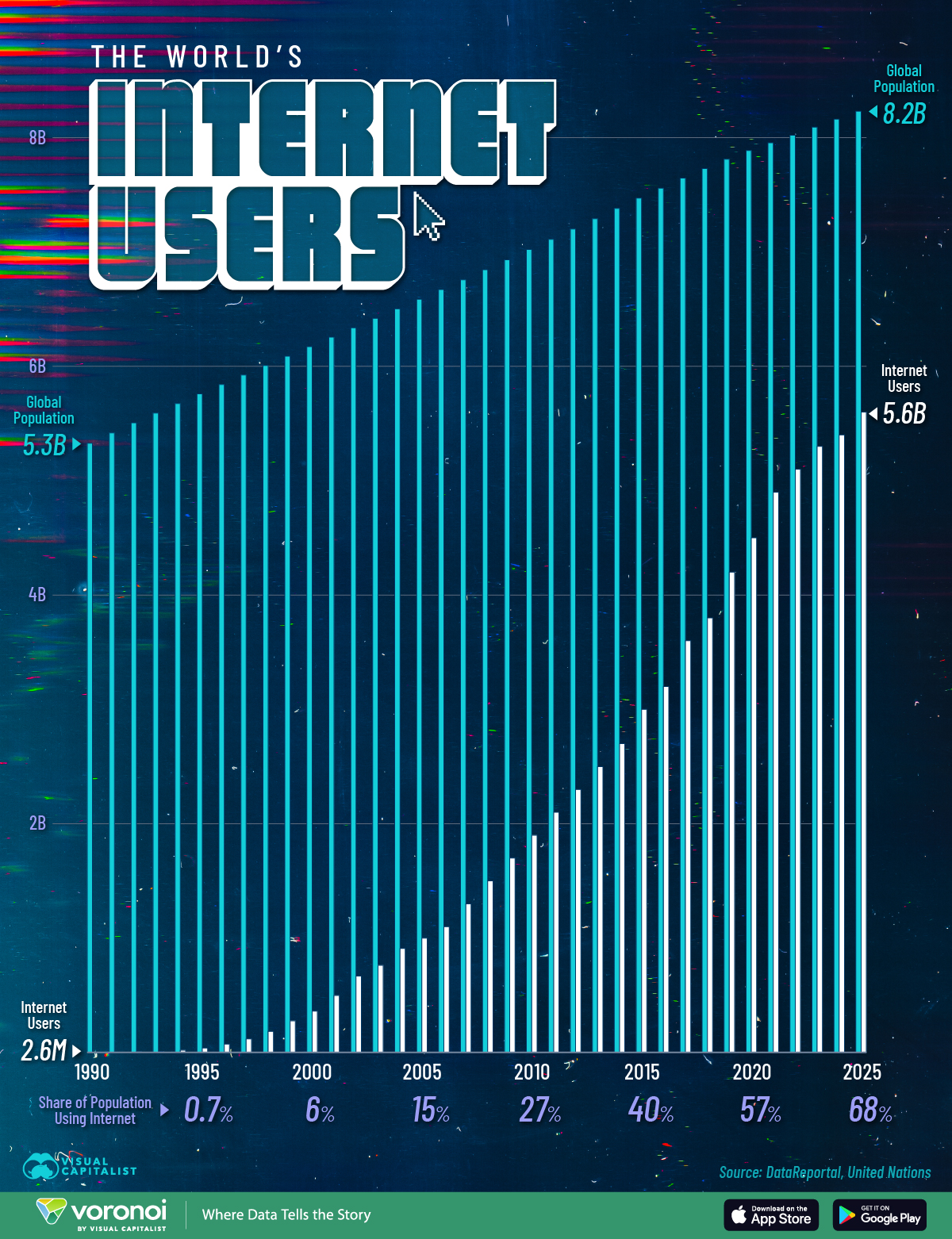
Why was that unforeseeable? Not because of a lack of intelligence, but because the relevant knowledge did not exist in any one place and probably could not. Over time, distributed experiments (and distributed human feedback) generated second-order effects. New business models appeared to take advantage of new infrastructure, such as 4G and broadband. User expectations shifted, and so did legal frameworks.
The Internet began as a narrow technical capability, but over time, it became part of the infrastructure, influencing a broader economic system. This process was slow, uneven, and chock-full of feedback loops. That yielded an economic system with great outcomes, but those were difficult to predict. Anybody who says they predicted this is selling something.
Return to digital music. After the turbulence of the Napster era, it would have been reasonable to conclude that the technology’s impact had been exaggerated. The industry was in conflict. Revenues were declining. Legal battles dominated headlines.
And yet, over the next two decades, a different system emerged. Streaming platforms aligned licensing, distribution, and user experience into a coherent model. The iPod, complemented by iTunes, turned out to be a bridge to a streaming future dominated by Apple Music on an iPhone and Spotify almost everywhere. Payment systems normalized subscriptions. Social features integrated discovery on social media with listening.
The long-run effect was not simply the digitization of music. It was the reorganization of how music is produced, distributed, discovered, and monetized. That outcome was not designed at the outset. It was assembled, piece by piece, through countless decisions made by a variety of participants responding to local conditions.
Now, think about Large Language Models in light of the experience of music. Early expectations are focused on first-order effects: faster computation, better comprehension, and more accurate models. All of that is fine, but the long-run impact comes from how these capabilities change as firms reorganize around these tools, how complementary systems develop, and how new forms of work emerge to support new services. Those cannot be forecast.
In other words, the economics behind Amara’s law teaches us to be humble about the long run. It may well be great, but such a characterization omits many relevant details. Those can only be discovered as the system unfolds.
A Shared Source of Error
It is tempting to treat the two halves of Amara’s Law as separate phenomena. Yet, both errors shared roots. Both stem from a focus on technology itself, rather than on the economic system into which it is introduced.
In both cases, the bias arises from the same community of technologists operating with the same mental models at an early moment. In the short run, they underestimate the economic frictions that slow adoption. In the long run, they underestimate the economic processes that amplify impact.
At the prototype stage, this focus is natural and necessary. Designers must abstract away from messy realities to make progress. Alas, economic life is both a messy swamp and a teeming system full of glorious variety.
Copyright held by IEEE Micro

