

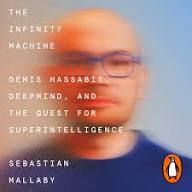
Demis Hassabis co-founded DeepMind, the lab startup where AlphaGo and AlphaFold were created. The latter won the Nobel Prize for Hassabis and his co-inventors. He truly is one of the most talented computer scientists of our age. This charming and best-selling book by Sebastian Mallaby, titled The Infinite Machine, provides insight into how Hassabis works and how he interacts with the people and organizations that collectively define the community around Artificial General Intelligence (AGI).
At its best, The Infinite Machine provides an intimate, immediate portrayal of AGI’s inventions. The book documents, in detail, just how contingent and, yes, improbable the development of modern AGI has become. Frontier invention and discovery require both obsession and compromise, resources and intuition, teamwork and visionary leadership.
Though it often gives voice to high-minded aspirations, the book also contains plenty of celebrity spotting for nerds. Hassabis rubs shoulders with scientists such as Geoffrey Hinton, Ilya Sutskever, and Jeff Dean, and commercial leaders, such as Sundar Pichai, Elon Musk, and Sam Altman, and they do things that sometimes border on the unbelievable. That will keep any reader engaged and elicit a range of reactions, from delight to disgust.

Constraint and Obsession
Hassabis’ early life follows a familiar narrative arc bordering on a trope. A child prodigy at chess from age six, he became one of Europe’s best under-13 players. He also experienced both exhilaration and burnout from a childhood diverted into such a high-pressure world. Predictably, he rebelled and developed a thirst for something else.
After finishing high school at 16, Hassabis joined a gaming company. A charismatic, manipulative founder led it and took Hassabis under his wing. Hassabis excelled at coding new game features. Though the experience contains shades of a modern Oliver Twist and Fagin, the episode does not leave a deep scar (to my surprise). Instead, it teaches Hassabis to enjoy the freedom and thrill of entrepreneurship.
After university, Hassabis founded a gaming venture called Elixir Studios. The effort encounters a gap familiar to any software entrepreneur: the one between the conceivable ambition and the computationally feasible. The ambitions brought Elixir into the spotlight, but the gap led to its downfall. After that experience, learning to manage that gap, whether software for gaming or science, becomes a recurring theme for Hassabis.

Hassabis returns to academia to pursue a PhD in neuroscience. That is not a misprint. The foundations of intelligence obsessed Hassabis. He became a lab rat, running experiments related to human memory and imagination. The experience becomes formative. Though he develops a taste for pursuing scientific goals, Hassabis learns that he does not have a taste for the (slow) rhythms of academic lab science. He also learns that he is drawn to modeling intelligence more than merely measuring human displays of it.
Boiled down to its essence, Hassabis reaches his mid-30s, wants to understand intelligence deeply, and feels at home in a gaming entrepreneurial setting. Those desires led to DeepMind’s founding, mission, and organizational form. That also explains why, at the time, there was nothing else quite like it.
Building DeepMind
The Infinite Machine frames the process of discovery not solely as a technical inquiry but as a deeply human endeavor. The underlying impulse remains essentially the same in many settings: the desire to push beyond known limits, to see what happens at the edge of possibility. That, more than any single achievement, is what this book captures best.
That topic takes the book into some highly technical material, and the author anticipates a non-expert reader, albeit an intelligent one. For example, it describes reinforcement learning and deep learning in depth without any math. It additionally provides a marvelous description of the invention of transformers and the variants that followed. All of this, frankly, requires an impressive delivery of intuitive verbiage.
The portraits of inventors in AGI are striking, too. When scientists confront problems with unknown solutions, they differ in how they approach them. Those reflect deep foundations and intuitions, as well as the imprint of faculty advisors, lessons from idiosyncratic histories, and rivalries.

When in doubt, inventors ask a friend for help. Lucky for Hassabis, he has loyal and exceptionally talented friends. The founding and growth of DeepMind is, in part, a story of collaboration among Hassabis, Shane Legg, John Jumper, and the itinerant David Silver. Their relationships and intellectual partnerships, which culminate in the development of AlphaGo and AlphaFold, are one of the other compelling threads in the book.
Speaking of partners, DeepMind’s early years put a spotlight on Mustafa Suleyman, who now leads a group at Microsoft and has penned his own book about the future. Every organization needs a right-hand man who is hungry for success and gets things done. With an unusual background and outlook, however, Suleyman both fits and defies the archetype. You have to read about his origins to believe it.

Hassabis grew up in the London area and wants to stay. The book gestures toward the region’s relative strength in technical talent and its comparative weakness in venture finance, with an emphasis on the latter. Aside from a few wealthy potential angel investors, Hassabis is out of luck when it comes to funding.
DeepMind confronts an inescapable dilemma. The pursuit of AGI requires the infrastructure and funding that only a handful of global firms and locations can provide. Hassabis eventually secured backing from Peter Thiel’s Founders Fund, and additional funding needs led Google to acquire the company in 2013. It is difficult to imagine an alternative path.
Dwell on that. London is not a financial or technology backwater. It makes anybody’s top cities for a world-class finance and technology hub. Yet, it seems to lack the necessary funders with sufficient capacity, patience, and risk tolerance for idiosyncratic, expensive entrepreneurialism. What a sobering observation. I was left wondering how many other UK-based ventures never materialized due to a lack of access to capital, appropriate mentors, and institutional support.
Themes
Though both Hassabis and Google gain from the combination, the book describes in much more detail how Hassabis gains and what he gave up. It also shows that better infrastructure is crucial, but Hassabis’s ambitions coexist uneasily with Google’s implementation of its mission. The book explores tensions over resource control and research discretion, as well as the difference between an organization with an engineering-driven and customer-focused mission and one with a scientific mission.
The book cannot help but compare Google and OpenAI, the latter of which was founded in late 2015. Both confront similar issues over public obligations and corporate missions. It is a massive oversimplification to say they manage them differently, and after all the complications settle, neither looks better than the other. The details defy a sweeping description other than “you cannot make this stuff up.” Again, it is one of the book’s compelling threads.

A question lurks behind all this: why pursue AGI at all? Every leader is fiercely competitive, and the desire to win for its own sake often takes over events. In his reflective moments, Hassabis also harbors a desire to understand the underlying structure of intelligence and, by extension, nature itself.
Among the other cast of characters, high-minded motives for undertaking a moonshot range from helping humanity, building a business, indulging in power, or acquiring gobs of money. On this foundation of influences from the citadel and street, distinct approaches to AGI emerge, both noble and profane.
The book never uses the phrase “the tech oligarchy,” but the shoe fits. In this portrait, Silicon Valley’s decision-makers come across as relentless and confident, moving with agency and entitlement, resistant to any limit on their discretion. The dynamics border on the astonishing and implausible: shifting alliances, governance crises, internal debates within firms that are themselves global institutions. Again, you can’t make this stuff up.

Not far from this topic are questions of safety, or, more precisely, the existential risks of AGI. The book accurately captures contemporary fears and explains why modern Cassandras see signs of things going awry. Relatedly, and once again, a frightening fact emerges: the preferences of only a small number of decision-makers shape safety-related decisions. Readers who take these issues seriously will react incredulously: The fate of humanity rests on the judgment of so few.
Where the Book Pulls Back
For all its expansiveness, The Infinite Machine occasionally drives right up to topics but does not completely cover them. It’s the reviewer’s job to notice. Here are two such topics that relate to core themes.
First, though invention receives attention, the book could have discussed deployment, integration, and adaptation. How does a discovery get transferred into Google services? The reader does not get a good sense of when discoveries shape Google’s services, nor why some work well in practical applications for widely delivered services.
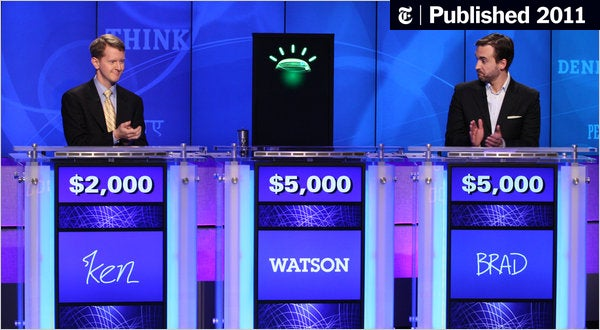
A related question sits just below the surface: Why do some discoveries in this area of computer science fail to deliver commercial payoff? For example, in 2011, IBM’s Watson computer beat human champions at Jeopardy! Yet, during the 2010s, IBM eventually lost billions of dollars trying to commercialize Watson. What is the difference between AlphaGo and Watson? Was it a failure among IBM’s leadership, a flaw in the integration, or the market to which this technology was first applied?
Second, the book omits a crucial player: the National Science Foundation (NSF) in the US and its UK equivalent, UK Research and Innovation (UKRI). The NSF is a federal agency that explicitly aims to fund US science that private industry underfunds but could yield large gains. With just a few bullseye hits, NSF can make up for many duds.
Fei-Fei Li and ImageNet can illustrate what happens when the NSF gets it right. Li’s efforts accelerated breakthroughs in neural networks by Geoffrey Hinton, Ilya Sutskever, and Alex Krizhevsky in 2012, and eventually led to Hinton receiving the Nobel Prize in 2024. The book accurately gives her credit for her initiative, foresight, and persistence.
What the book does not say: NSF gave Li half a million dollars in 2009, when no one else would. Society undeniably got an enormous return on this NSF investment. Relatedly, UKRI gave Hassabis nothing, and he had to search widely for funding. These could have been an important counterbalancing point to the numerous organizational tensions surrounding public obligations at Google and OpenAI.
A recommendation
Insider accounts with this much richness are rare. Mallaby has a storyteller’s sense of when to follow Hassabis closely and when to pull back to survey the broader landscape. As a result, the book is engaging and often astonishing.
Still, the book falls at the boundary between history and journalism, especially when covering current events in the 2020s. These accounts lack the benefit of hindsight. The Infinite Machine could not possibly have foreseen events such as the explosive growth of coding assistants or the bottleneck in advanced data centers. Read it soon before the latter parts of the book become dated.
Copyright held by IEEE Micro
 Digitopoly